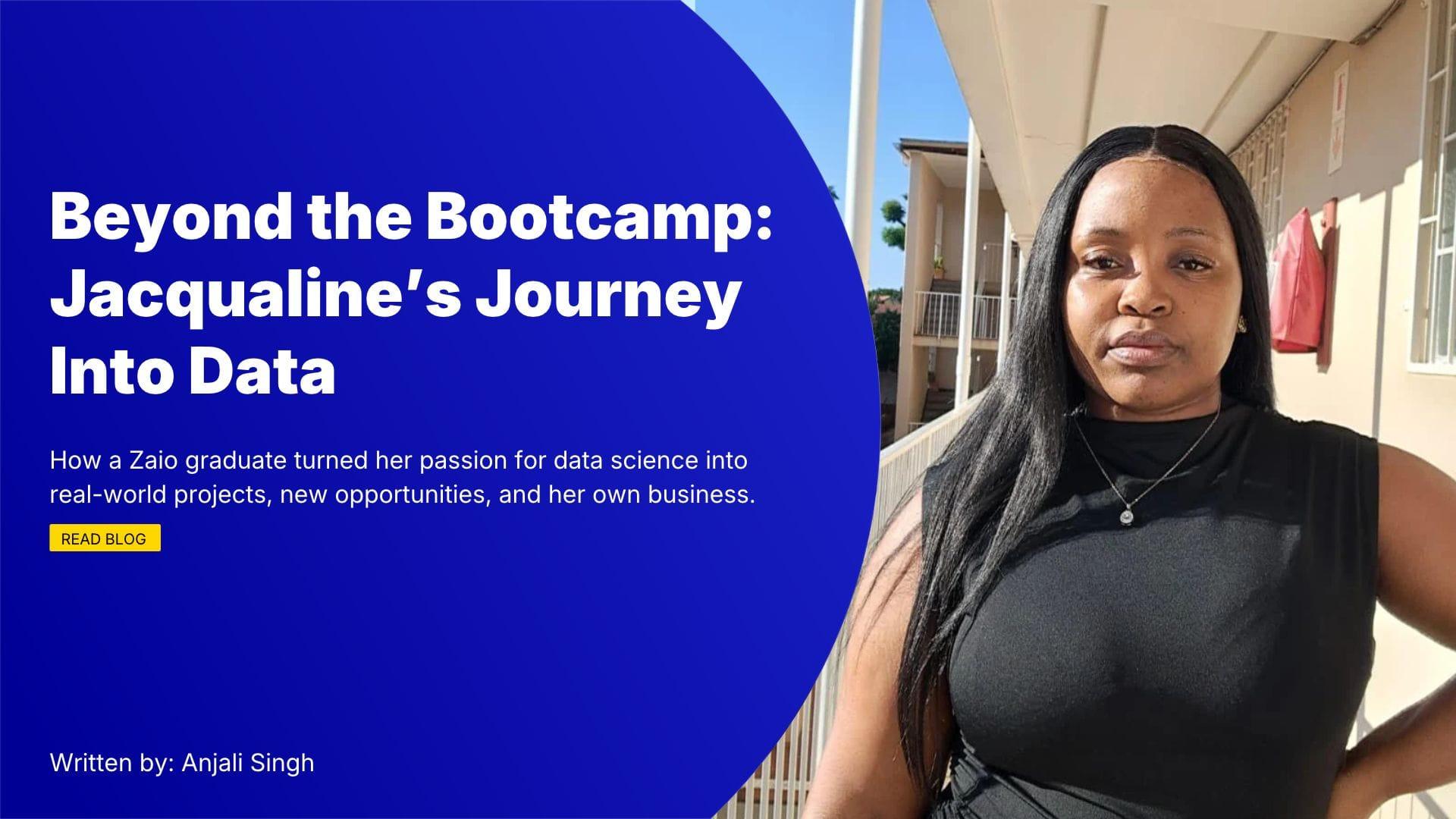
From Call Centre Agent to Business Founder: Jacqualine’s Data Science Journey
Discover how Jacqualine Makgolane moved from call centre work into data science, built a machine learning project and launched her own business through her Zaio journey.
On this page
- A data science journey that did not start perfectly
- Why data science stood out to her
- From WesBank call centre agent to future data professional
- Finding Zaio and making a strategic decision
- More than a course
- The real challenge: showing up consistently
- Learning data science without taking shortcuts
- Building a real data science capstone project
- Why GitHub became part of her portfolio
- Solving problems like a real data scientist
- The moment it paid off
- Growing as a communicator
- What comes next for Jacqualine
- Jacqualine’s advice: do it scared
- Looking back: a “Masterpiece”
- Start building your future in data
- Frequently asked questions
Key takeaways
Jacqualine Makgolane joined Zaio after previous attempts to enter tech were interrupted by distance, work commitments, and life circumstances. Even after being unable to complete an earlier data science programme, her interest in data never went away.
Through Zaio, she completed a data science journey that helped her build consistency, gain technical confidence, work on a real vehicle price prediction capstone project, and turn that project into something she could showcase on GitHub.
Her growth went beyond technical skills. Jacqualine says the journey helped her realise what she was capable of, improve her communication, and move from thinking like a student to thinking like someone in the industry.
By the end of her Zaio journey, she had registered her own business intelligence consulting company, Seryon J, and had already secured her first clients.
Her advice to anyone who feels scared about starting a career in tech is simple: “Do it scared.”
A data science journey that did not start perfectly
Not every tech journey begins with confidence, clarity, or a perfect plan.
For Jacqualine Makgolane, the path into data science started with curiosity, a few setbacks, and a decision to keep going even when things didn't work out the first time.
Before joining Zaio, Jacqualine had already tried to enter the tech space. In 2023, she joined a data science programme through another institution, but the programme required in-person attendance several times a week. Because of the distance, she could not commit fully and was eventually dropped from the programme.
For many people, that could have been the end of the story.
For Jacqualine, it became confirmation.
Even though she only experienced that programme for a short time, it showed her that data science was something she genuinely cared about. The interest stayed with her. She continued watching videos, researching the field, and looking for a way back into data.
That is what makes her story so relatable. She did not enter tech because everything was easy. She entered because the interest kept coming back.
Why data science stood out to her
Jacqualine was always drawn to technology and data because of what data makes possible.
For her, data is not just about numbers. It is about turning information into something people can understand, explain, and use. She described it as the ability to take numbers that may not make sense to others and turn them into insights that do.
That mattered because Jacqualine also saw herself as someone who enjoys communication. She liked the idea of presenting findings, explaining patterns, and using data to tell a clearer story.
This is one of the biggest misconceptions about data science. People often think it is only about coding, maths, or technical tools. Those things matter, but data science also needs communication, curiosity, problem-solving, and the ability to explain what the numbers actually mean.
For Jacqualine, that combination made data feel like the right direction.
From WesBank call centre agent to future data professional
After her first attempt at data science, Jacqualine later joined another learnership but could not finish because she got a job at WesBank. There, she worked as a call centre agent, dealing with system-related issues and customer queries.
The role taught her a lot, but over time she realised it was not where she wanted to stay.
The work became predictable. She knew what certain customer issues would look like, how she would solve them, and what the process would be. But Jacqualine wanted work that challenged her more deeply. She wanted to think through different kinds of problems, not repeat the same type of solution every day.
Data offered that.
“With data, it allows you to think outside of the box. You’re always getting different queries every time.”
That desire for more complexity pushed her to search for a way to transition into the data field properly.
Finding Zaio and making a strategic decision
While researching ways to transition into data science, Jacqualine came across Zaio on TikTok. She explored the website, looked into the programme and considered whether it would fit her career goals.
Already working at WesBank, she wanted to build the skills needed to move into the data field without giving up on her ambitions. After researching her options, she decided that Zaio offered the structured learning and practical experience she was looking for.
That decision says a lot about her mindset. Jacqualine was not just looking for a certificate. She was thinking about her future, her current environment, and how to create a more realistic path into the career she wanted.
That is an important lesson for anyone considering a data science bootcamp in South Africa. The right programme should not only teach you skills. It should help you connect those skills to your real career goals.
More than a course
When Jacqualine first joined Zaio, her goal was simple: complete the programme, develop practical data science skills and work towards a career in the field.
But her journey became much bigger than that.
As she moved through the programme, she started to see new possibilities for herself. She realised that learning data science was not only about qualifying for a new role. It was also about building the confidence to create something of her own.
By the end of the programme, Jacqualine had registered her own business intelligence consulting company, Seryon J, using the experience and knowledge she gained through Zaio.
She later confirmed that she started the company by herself and had already secured her first clients.
That is what makes this a true student success story. Jacqualine did not only complete a learning programme. She used the skills, structure, and confidence she gained to start building a future beyond the classroom.
The real challenge: showing up consistently
Jacqualine is honest about what made the journey difficult.
It was not that she lacked tools or support. In fact, she said Zaio offered the platform, tools, resources, mentorship, and tutors she needed.
The real challenge was showing up consistently.
This mattered because Jacqualine had previously struggled to complete other programmes. When she joined Zaio, part of her fear was whether she would finish this time.
Instead of relying only on motivation, she built accountability into her routine.
About two weeks into the programme, she joined the Zaio Discord and found two other students who shared the same goal. Together, they formed a small study group and committed to meeting every day at 8pm, Monday to Sunday. They worked through activities, joined video calls, discussed code, shared screens, and kept each other accountable.
They were not perfect. Sometimes they were late. Sometimes they postponed. But they made sure they did not miss two days in a row.
For anyone learning to code or data science online, that lesson is powerful.
You do not need to feel motivated every day. You need a system that helps you keep going when motivation drops.
Learning data science without taking shortcuts
One of the most interesting parts of Jacqualine’s story is how she approached AI tools.
Like many students, she sometimes felt tempted to use AI when she got stuck with code. But over time, her study group noticed that the more they relied on AI tools, the less they were actually gaining from the learning experience. So they made a decision to cut back.
Her conclusion was simple: easier routes exist, but they do not always build understanding.
“There are no shortcuts to anything,”
That mindset matters in data science. AI tools can support your workflow, but they cannot replace the learning process. You still need to understand the problem, read the error, reason through the logic, test your approach, and know why your solution works.
This is one of the differences between simply finishing a task and actually becoming skilled.
Building a real data science capstone project
For her capstone project, Jacqualine worked with a used vehicle dataset and built a predictive model to help estimate vehicle prices.
The project was practical because vehicle pricing is a real-world problem. It can be difficult to look at a used vehicle and decide on a fair price. Her model was designed to help estimate a price that was as close and reasonable as possible, reducing the risk of overcharging or undercharging.
But what stood out most was how she approached the project.
Jacqualine did not want to do only what was required. She wanted to go further, build something more complete, and think beyond the mindset of a student.
“If I’m going to build a model, maybe let’s see it in real life and see how it will work. Let me think like a data scientist, not a student.”
That mindset is exactly what strong tech portfolios are built on. The goal is not only to submit work. The goal is to build something that shows how you think, how you solve problems, and how you turn a technical idea into something useful.
Why GitHub became part of her portfolio
Jacqualine uploaded her project to GitHub because she wanted her progress documented in real time.
For her, GitHub was not just a place to store code. It became a timeline of her growth. She wanted to see the changes, the adjustments, the days she showed up, and the progress she made along the way.
She also understood that GitHub could become part of her portfolio for potential employers.
That is an important lesson for anyone trying to enter data science, software development, or any technical field. A certificate can show that you completed a programme, but a portfolio shows what you can actually build.
When employers or clients look at your GitHub, they are not only looking for perfect code. They are looking for evidence of problem-solving, consistency, improvement, and practical application.
Jacqualine understood that.
Solving problems like a real data scientist
During her capstone project, Jacqualine ran into an issue she had not experienced before.
She tried to optimise the full dataset, but her laptop could not handle the processing load. The data kept taking too long to process, and she eventually realised that her laptop’s RAM capacity was part of the problem.
Instead of giving up, she adjusted her approach. She used a sample of the dataset that could still represent the data without overwhelming her machine. Once she did that, the processing worked.
That moment taught her something practical about working with data: technical skill is not only about knowing tools. It is also about making decisions, understanding constraints, adapting your approach, and finding a workable solution with the resources you have.
That is the kind of thinking that moves someone from beginner to practitioner.
The moment it paid off
When Jacqualine received her capstone results, she was at the mall. She checked her email and saw that she had received 81%. Later, when she checked her transcript, she saw that her final mark was 85%.
But the mark was not the only achievement.
The bigger achievement was that she had finished.
When she started in February, the goal felt far away. By the end, she could look back at the late nights, study sessions, sacrifices, missed social time, and moments of doubt and know that she had shown up for herself.
For Jacqualine, that mattered deeply because the journey was not only technical.
“The technical skills are there, but the feeling of knowing that you are capable is much more personal.”
Practical skills matter, but confidence matters too. When students start believing they can solve problems, explain their work, and keep going when things get hard, the learning becomes more than a course. It becomes a shift in identity.
Growing as a communicator
Jacqualine’s growth was not limited to coding and data.
She also became more confident in how she communicated her work. During the programme, she had weekly meetings with her mentor, Buhle, who challenged her to present her projects and explain her thinking. At first, she was scared of saying the wrong thing. Over time, she learned to articulate her ideas better.
That confidence also developed through her study group. She often found herself explaining concepts to fellow students in simpler terms, which helped her improve her own understanding.
This matters because tech careers are not only about technical ability. Whether you become a data scientist, analyst, developer, or consultant, you need to explain your work. You need to present ideas, communicate decisions, and help others understand the value of what you built.
By the end of her journey, Jacqualine felt she had gone from thinking like a student to thinking like someone in the industry.
What comes next for Jacqualine
For Jacqualine, the goal is still clear: she wants to build a future in data, whether that is as a data scientist or in a related role such as analytical engineering.
But her Zaio journey has also opened up something bigger. Through her business, Seryon J, her DriveValue AI project, and her volunteer role as a Research Associate at the Africa Center for Strategy and Policy, Jacqualine is already starting to apply her skills beyond the classroom.
She did not just complete a bootcamp. She started building a professional identity around data, business intelligence, and real-world problem-solving.
Jacqualine’s advice: do it scared
When asked what she would say to someone who wants to get into tech but feels scared or intimidated, Jacqualine’s answer was direct:
“Do it scared.”
Do it before you feel fully ready. Do it with less confidence than you wish you had. Do it while the goal still feels far away.
Her point is not that fear disappears before you start. It is that confidence often comes after action.
“The more you don’t do something because you’re scared,” she said, “the more you’re proving to yourself that you’re incapable.”
For beginners, career switchers, and anyone wondering whether they are “technical enough” to enter data science, that message matters.
You do not need to start with certainty.
You need to start.
Looking back: a “Masterpiece”
When Jacqualine looks back at her Zaio journey, she describes it in one word:
“Masterpiece.”
For her, it was a journey of transition from a field she knew into one that once felt completely unknown. It was a journey of growth, discipline, confidence, late nights, practical learning, and personal transformation.
She joined Zaio hoping to complete the programme and transition into data. Along the way, she gained practical experience, built her confidence and discovered new opportunities for herself.
She left with technical skills, a completed capstone project, a GitHub portfolio, a registered business, a stronger voice, and a deeper belief in what she is capable of.
That is what student success can look like.
Not just getting through the programme.
Growing through it.
Start building your future in data
Jacqualine's story shows what can happen when curiosity meets consistency, practical learning and the right support.
Interested in building a career in data? Explore Zaio's Data Science and Machine Learning Bootcamp, where learners develop practical skills in Python, data analysis, visualisation and machine learning through hands-on projects.
Start building the skills to create your own opportunities in tech.
Frequently asked questions
1. Can you start a career in data science without a technical background?
Yes. Although some data science roles require formal qualifications, beginners can start developing practical skills in Python, data analysis and machine learning without previous coding experience. Jacqualine's journey shows how structured learning, consistent practice and practical projects can help someone work towards a career in data.
2. What skills did Jacqualine learn through Zaio?
Through her data science studies at Zaio, Jacqualine developed practical experience in analysing datasets, building predictive models, troubleshooting technical problems and presenting her work. She also improved her problem-solving, communication and project development skills.
3. What data science project did Jacqualine build?
Jacqualine developed DriveValue AI, a used vehicle price prediction project that applies machine learning to estimate vehicle prices. She also created a web interface and published her work on GitHub to showcase her technical skills and development process.
4. Can a data science bootcamp help you build a professional portfolio?
Yes. Project-based data science bootcamps can help learners create work that demonstrates their technical abilities. Jacqualine used GitHub to document her project, track improvements and build a portfolio that potential employers could explore.
5. Can learning data science help you start your own business?
Data science skills can support entrepreneurship by helping businesses analyse information, identify trends and make informed decisions. After completing her Zaio programme, Jacqualine registered Seryon J, a business intelligence consulting company, and began working with her first clients.
6. How does Zaio support students learning data science online?
Zaio provides structured online learning, practical projects, tutor support and opportunities to connect with other learners. During her studies, Jacqualine formed a study group through the Zaio community and received guidance from tutors and a mentor, helping her stay consistent and improve her technical and presentation skills.
7. What advice does Jacqualine have for people considering a career change into tech?
Her advice is simple: "Do it scared." Jacqualine encourages beginners to take the first step even when they feel uncertain. Her experience shows that confidence can grow through consistent learning, asking for help and working through challenges.
Written by
Anjali Singh