From Biological Sciences to Data Science | Zaio Graduate Story
From Biological Sciences to data science, discover how Chantel Kola found her path into tech through practical learning, student support and persistence.
On this page
- Key takeaways
- Can you transition into data science from a non-tech degree?
- The hardest part was choosing where to start
- Learning Python was not easy
- The “Red Day” that changed how she learned
- How a study group made coding less intimidating
- Daily assignments built discipline
- What do you learn in Zaio's Data Science and Machine Learning bootcamp?
- From “Did I make the wrong choice?” to “I can figure this out”
- Failure became part of the learning process
- 3 lessons from Chantel's switch into data science
- What’s next for Chantel?
- Thinking about your own career transition into Data Science?
- Frequently asked questions
- 1. Can I become a data scientist with a non-tech degree?
- 2. Can I move into data science from Biological Sciences?
- 3. Do I need to know Python before joining a data science bootcamp?
- 4. Is SQL hard for beginners?
- 5. What skills do you need to start learning data science?
- 6. How does Zaio support data science beginners?
- 7. What can career switchers learn from Chantel’s story?
Key takeaways
A non-tech degree does not have to stop you from building a career in data science. Chantel Kola’s journey shows how curiosity, analytical thinking, structured learning, and the right support can help you move from a science background into tech.
Chantel’s interest in data grew from her science background, where she saw how biological conclusions often depend on analysing information and identifying patterns.
Learning Python and SQL was not easy at first. Like many beginners, Chantel experienced confusion, self-doubt, and moments where she questioned whether she had chosen the right path.
Her progress came from consistency, daily assignments, tutor support, and a four-person study group that made the learning journey feel less intimidating.
For students, graduates, and career switchers wondering how to get into data science without a computer science degree, Chantel’s story is a reminder that the starting point matters less than the willingness to keep learning.
Changing careers rarely happens in one perfect moment.
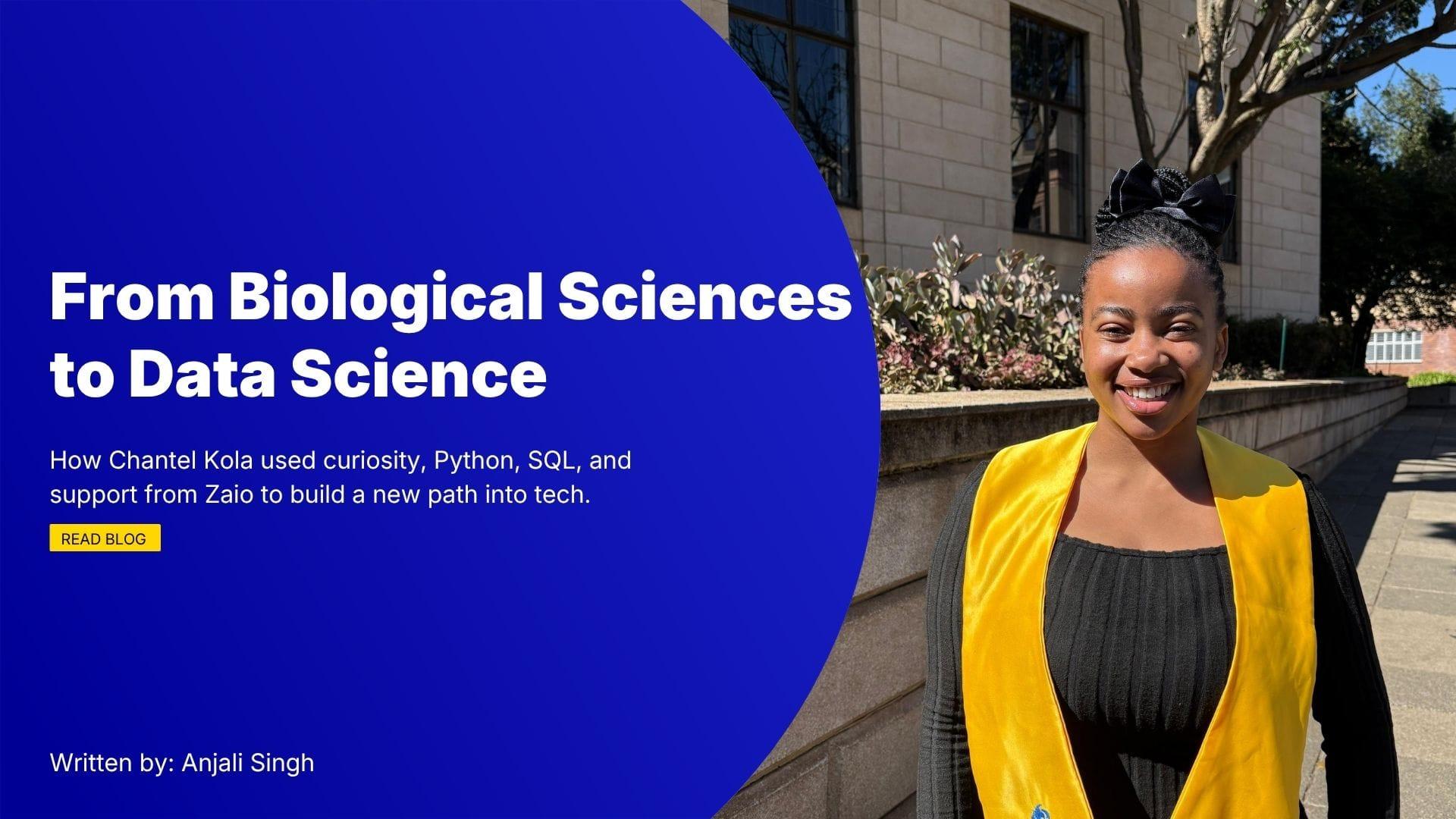
For Chantel Kola, the move from Biological Sciences into data science started with a simple realisation: the part of her degree she enjoyed most was not only the lab work. It was the data behind it.
After completing her BSc in Biological Sciences, Chantel began thinking more seriously about what she wanted her career to look like. She earned two Microsoft certifications, started exploring the tech industry, and eventually chose data science as the direction she wanted to pursue.
Then came the harder part.
Learning to code.
Python was more difficult than she expected. SQL was completely new. There were moments where she felt lost and wondered whether she had made the wrong decision.
But instead of treating that uncertainty as proof that she did not belong in tech, Chantel slowly learned to see it as part of the process.
Her story is especially useful for anyone asking questions like:
- Can I become a data scientist without a computer science degree?
- Can I move into tech from a science background?
- Is data science beginner-friendly?
- What is it like to learn Python and SQL for the first time?
- How can Zaio help career switchers enter data science?
Can you transition into data science from a non-tech degree?
Yes. You can transition into data science from a non-tech degree if you are willing to build the right technical skills, practise consistently, and apply what you learn through projects.
A computer science degree can help, but it is not the only route into data. Many career switchers enter the field from backgrounds like science, finance, engineering, business, statistics, economics, and healthcare.
For Chantel, Biological Sciences did not hold her back. In fact, it helped her notice something important.
A lot of scientific work depends on data.
You collect information, analyse it, look for patterns, draw conclusions, and communicate what those conclusions mean. That connection helped Chantel see data science as a natural next step rather than a completely unrelated career path.
Her background gave her a foundation in curiosity, problem-solving, and analytical thinking. What she needed next was structure, technical training, and support.
Microsoft defines data science as a multidisciplinary process that transforms messy, structured and unstructured data into actionable insights through statistical analysis, machine learning, and artificial intelligence, ultimately uncovering trends, challenging assumptions, and enabling informed decisions and innovation.
The hardest part was choosing where to start
One of the first challenges Chantel faced is something many beginners experience.
Tech is broad.
There is software development, data analysis, data science, cybersecurity, cloud computing, artificial intelligence, DevOps, UX/UI, product management, and more.
For someone just starting out, the number of options can feel overwhelming.
Chantel had to move past the idea that she needed to understand every possible tech career before starting. Instead, she chose one lane.
For her, that lane was data.
That decision gave her direction. Not perfect certainty, but enough clarity to start moving forward.
This is an important lesson for anyone trying to enter tech. You do not need to know everything before you begin. You need a direction, a learning path, and the willingness to keep going long enough to build real skills.
If you are still comparing different routes, Zaio’s course comparison page can help you explore pathways like Data Science and Machine Learning Bootcamp, Cybersecurity, Full Stack Web Development, and Full Stack AI Engineering.
Learning Python was not easy
Before joining Zaio, Chantel had heard that Python was one of the easier programming languages to learn.
Then she actually started learning it.
The experience was more difficult than she expected.
There were new concepts, unfamiliar ways of thinking, and moments where the code simply did not make sense. SQL was also new to her, which meant she had to build comfort with both programming logic and database thinking at the same time.
That part of her journey matters because many course pages make learning sound neat and linear.
- Learn Python.
- Learn SQL.
- Build projects.
- Become job-ready.
But real learning rarely feels that smooth.
Sometimes you understand a concept quickly. Sometimes you stare at the same error for an hour. Sometimes you wonder if everyone else understands something you do not.
Chantel’s progress came from learning not to interpret confusion as failure.
It was simply part of learning something new.
The “Red Day” that changed how she learned
One of the most important moments in Chantel’s journey came from a difficult day during the bootcamp.
She became familiar with the idea of avoiding a “red day”, a day where no studying happens at all.
Then she had one.
The reason was simple: she did not understand the work.
At first, that could have become a reason to pull back or doubt herself even more. Instead, it became a turning point.
Chantel realised that being stuck was not a sign to stop. It was a sign to ask for help.
She reached out to her tutor and classmates. They helped her work through the assignment, and asking for support became part of how she learned.
That changed the question from:
“Why don’t I understand this?”
to:
“Who can I ask, and what can I try next?”
That mindset is one of the most valuable skills a beginner can develop.
How a study group made coding less intimidating
Human support became a major part of Chantel’s progress.
She and three classmates formed a four-person study group where they could work through difficult concepts together. They discussed confusing assignments, helped each other understand mistakes, and made the learning process feel less lonely.
That support did more than help with individual coding problems.
It made struggle feel normal.
If one person did not understand something, they could talk it through. If someone got stuck, they had people to ask. If a concept clicked for one person first, they could help the others.
Over time, Chantel became more comfortable trying things she might get wrong.
That confidence mattered in Python and SQL, but it also mattered in the bigger career transition.
She was no longer trying to make the move into data science alone.
Zaio’s wider bootcamp learning model is built around this idea of structured learning, support, community, and practical projects.
Daily assignments built discipline
Motivation is useful at the start of a journey.
But when the work gets difficult, motivation is not always enough.
Chantel’s experience at Zaio required consistency. There were assignments to complete and work to submit regularly, which helped her keep moving even when she did not feel fully confident.
That structure taught her accountability. It helped her finish what she started. It also helped her build the habit of showing up, even when the work was uncomfortable.
That lesson matters beyond data science.
In tech, there will always be another bug, another difficult dataset, another unfamiliar tool, or another problem you have not seen before.
The ability to keep working through uncertainty becomes a skill of its own.
What do you learn in Zaio's Data Science and Machine Learning bootcamp?
Zaio’s Data Science and Machine Learning Bootcamp is designed as a beginner-friendly route into data science for students, graduates, and career switchers.
Zaio's Data Science and Machine Learning bootcamp introduces learners to practical data skills through Python, Pandas, NumPy, data visualisation and machine learning. Students work with datasets and develop projects that help them apply what they've learned.
These skills align with common data science workflows. IBM explains that data science involves preparing and extracting data, working with databases and SQL, using programming languages such as Python, and applying techniques such as machine learning and data visualisation.
The goal is not only to help learners understand data science concepts. It is to help them practise with the tools and workflows used to analyse information, solve problems, and build confidence with data.
For career switchers like Chantel, this matters because you may enter with strong analytical thinking but limited coding experience. A structured bootcamp helps turn that potential into practical skill.
From “Did I make the wrong choice?” to “I can figure this out”
Perhaps the biggest transformation in Chantel’s story was not only technical.
It was the shift in how she approached problems.
At the beginning, Python and SQL felt intimidating. Difficult assignments made her question herself. But over time, she became more comfortable with the process of trying, failing, asking questions, and trying again.
Python became more familiar.
SQL became less foreign.
Difficult modules became milestones.
And the career transition that initially felt overwhelming started to feel possible.
For someone searching “can I get into tech without a degree?” or “can I become a data scientist from a science background?”, Chantel’s experience points to a practical answer:
You do not need to arrive with everything figured out.
You need to start, practise, build support around you, and keep learning when it gets difficult.
Failure became part of the learning process
Chantel’s advice to someone making a similar transition is simple:
“Don’t be afraid to fail.”
Her reasoning is that if you are never failing, you are probably not stretching yourself beyond what you already know.
She also explained:
“If you’re not failing, it means you’re not learning anything.”
That perspective is especially important when learning technical skills.
Your code will break.
Queries will sometimes return the wrong result.
You will misunderstand concepts.
Projects may take longer than expected.
The goal is not to avoid all of that. The goal is to become someone who knows what to do when it happens.
For Chantel, that meant trying again, asking questions, leaning on her peers, and refusing to let one difficult day decide whether she belonged in data science.
3 lessons from Chantel's switch into data science
Chantel's experience offers practical lessons for anyone considering a career change into tech.
1. Your previous qualification doesn't have to limit your next career move. Chantel studied Biological Sciences before exploring data science. Her background helped develop the curiosity and analytical thinking she brought into learning new technical skills.
2. Asking for help is part of learning. When Python became challenging, Chantel relied on tutor support and other students to work through difficult concepts rather than giving up.
3. Progress comes from consistent practice. Through assignments, study sessions and working through mistakes, Chantel gradually developed more confidence in her ability to solve problems.
Her experience is a reminder that changing careers doesn't require knowing everything from the beginning. It requires the willingness to learn and keep improving.
What’s next for Chantel?
Completing the bootcamp is not where Chantel sees the journey ending.
Her next goal is to keep sharpening her skills, build more projects, and continue applying for opportunities. She also brings a strong academic track record to her journey as a Golden Key member and former Golden Key Committee member.
But perhaps the most valuable thing she carries forward is the lesson she learned while struggling through unfamiliar code:
Not understanding something today does not mean you cannot understand it tomorrow.
Sometimes the next step is another attempt.
And sometimes it is simply asking someone beside you for help.
Thinking about your own career transition into Data Science?
If you enjoy working with numbers, analysing information, solving problems, and figuring out why things happen, data science could be a career worth exploring.
You do not need to arrive already knowing Python.
You do not need to have every step of your career mapped out.
But you do need to be willing to learn, practise, ask questions, build projects, and keep going when something does not make sense the first time.
That is what Chantel’s story demonstrates.
Her journey did not become possible because learning suddenly became easy.
It became possible because she kept learning when it was not.
Explore Zaio’s Data Science and Machine Learning Bootcamp
Frequently asked questions
1. Can I become a data scientist with a non-tech degree?
Yes. A non-tech degree does not prevent you from moving into data science. You will need to build technical skills like Python, SQL, data analysis, and machine learning, but your previous background can still give you useful problem-solving and analytical experience.
2. Can I move into data science from Biological Sciences?
Yes. Biological Sciences can be a strong starting point because the field often involves data, research, analysis, and evidence-based conclusions. Chantel Kola’s journey shows how a science background can lead naturally into data science.
3. Do I need to know Python before joining a data science bootcamp?
Not always. Beginner-friendly data science bootcamps are designed to help learners start from the basics. What matters most is consistency, practice, and willingness to ask for help when concepts feel difficult.
4. Is SQL hard for beginners?
SQL can feel unfamiliar at first, especially if you have never worked with databases before. But with practice, it becomes easier to understand how data is stored, queried, filtered, and analysed.
5. What skills do you need to start learning data science?
Useful starting skills include problem-solving, curiosity, basic maths confidence, consistency, and willingness to practise. Technical skills usually include Python, SQL, data analysis, statistics, data visualisation, and machine learning basics.
6. How does Zaio support data science beginners?
Zaio supports learners through structured lessons, practical assignments, tutor support, peer learning, projects, and career-focused guidance. This helps beginners build confidence instead of trying to figure everything out alone.
7. What can career switchers learn from Chantel’s story?
Chantel’s story shows that uncertainty is normal, asking for help matters, and progress comes from consistency. A non-tech background does not mean you are starting too late. It may simply mean you are bringing a different perspective into tech.
Written by
Anjali Singh