How a Zaio Student Built Elev8U, an AI Freelancer Marketplace for South Africans
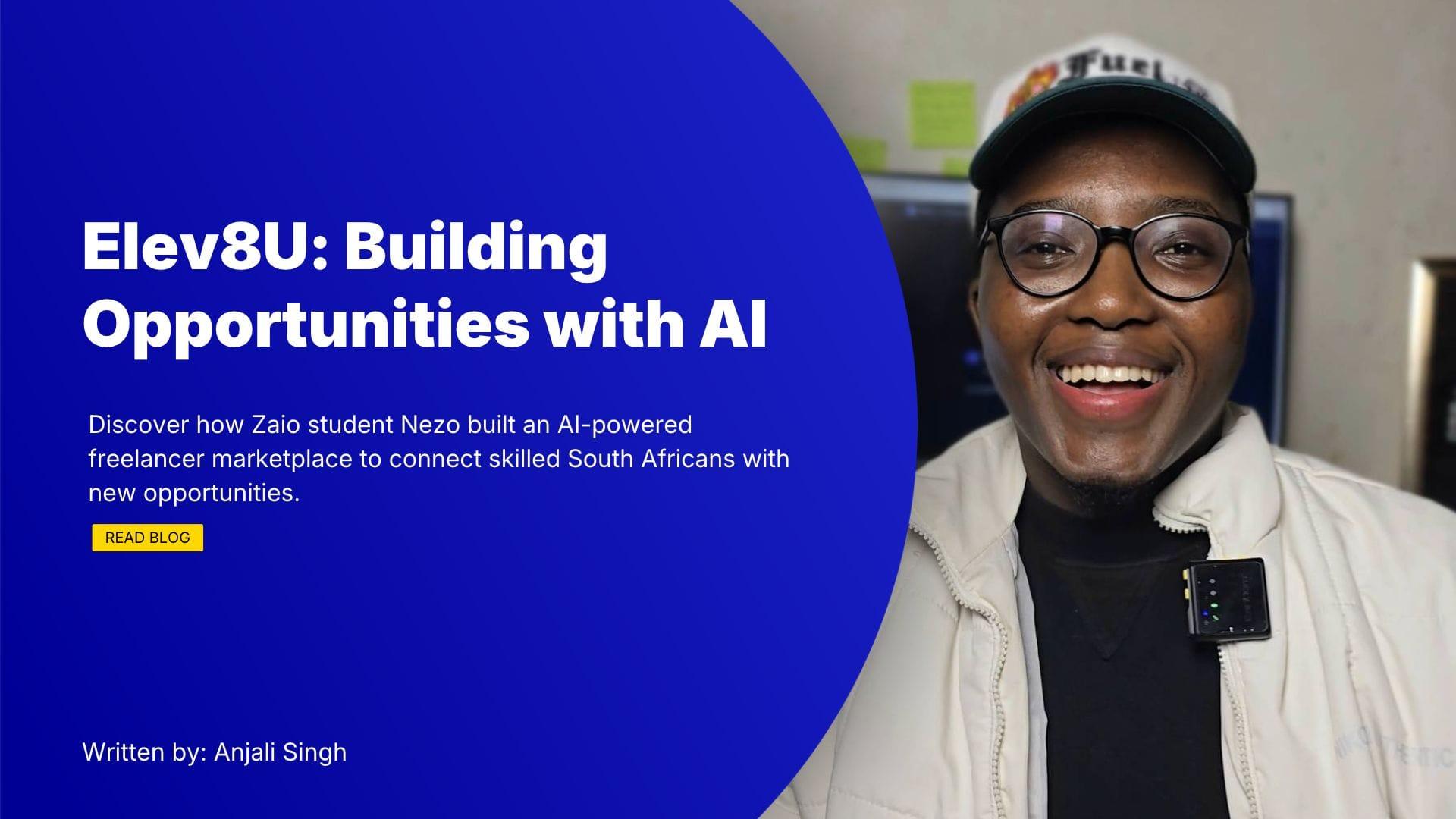
Meet Elev8U, an AI-powered freelancer marketplace built by Zaio student Nezo to connect skilled South Africans with clients and new opportunities.
On this page
- Key takeaways
- Project boost: showcasing what Zaio students build
- What is Elev8U?
- The problem Elev8U is trying to solve
- How Elev8U works
- The freelancer side: pricing, subscriptions and ratings
- What makes Elev8U different?
- How Nezo built the first version
- The tech behind Elev8U
- What Zaio helped him understand
- Building with AI without losing control
- Launching the first version
- Feedback as part of the build
- What’s next for Elev8U?
- Advice to other students: ship it
- Why projects like Elev8U matter
- Ready to build your own AI-powered project?
- Frequently asked questions
Key takeaways
Elev8U is an AI-powered freelancer marketplace built by Zaio student Nezokuhle Tshukulwana to help skilled South Africans connect with clients and turn their skills into income.
The platform works by using AI matchmaking to connect clients with freelancers based on what they need, where they are based, their budget, and their timeline.
Nezo built the first version of Elev8U as a web-based platform, using tools such as Claude Code, Supabase, SQL, and prompt engineering while applying what he learned through Zaio’s Full Stack AI Engineering Bootcamp.
For Nezo, the biggest lesson was not just how to use AI, but how to understand, direct, question, and improve what AI helps you build.
Elev8U launched in June 2026 and had seven users at the time of the interview, with future plans to add payments, financial tracking, financial analysis, and more platform features.
Project boost: showcasing what Zaio students build
At Zaio, we believe the best way to learn tech is not just by watching tutorials or completing lessons. It is by building real things.
That is the idea behind Project Boost, a Zaio blog series that spotlights the projects our students are creating. Instead of focusing mainly on the student’s personal journey, Project Boost goes inside the project itself: the problem, the idea, the build, the tools, the challenges, the lessons, and the impact.
For this feature, we are looking at Elev8U, an AI-powered freelancer marketplace built by Zaio student Nezokuhle Tshukulwana, also known as Nezo.
Elev8U is not just a class project. It is a practical platform built around a real South African problem: many people have valuable skills, but not everyone has access to the right platform, network, or opportunity to turn those skills into income.
What is Elev8U?
Elev8U is an AI-powered freelancer marketplace for South Africans.
Nezo describes it as an AI matchmaking platform, similar in some ways to Fiverr or Upwork, but built with South African users in mind. His idea came from seeing skilled people, from web developers to plumbers, who had the ability to provide value but did not always have a place to profit from those skills.
For Nezo, the project was also a response to a narrative he strongly disagrees with: that South Africans are lazy or lack skill. His view is different. He believes many South Africans are skilled, but often lack access to the right opportunities.
That is the core problem Elev8U is trying to solve.
It gives freelancers a space to showcase their skills, set their own prices, receive reviews, build trust, and connect with clients who are actually looking for what they offer.
The problem Elev8U is trying to solve
South Africa has people with valuable skills, from web development and accounting to plumbing and mechanical work, but finding paying clients is not always straightforward.
Nezo wanted to create a platform that helps skilled individuals become more visible and turn their abilities into income. Rather than building another general freelance marketplace, he focused on the needs of South African users, including local pricing, location-based matching and accessible services.
That idea became Elev8U: a platform designed to connect people who need work done with people who have the skills to do it.
How Elev8U works
Elev8U has two main sides: the client side and the freelancer side.
On the client side, a person might be looking for a specific service, such as a plumber, web developer, accountant, or mechanic. Instead of manually searching through endless profiles, the client can use the platform’s AI chat system.
The AI asks four key questions:
From there, the AI matchmaking system connects the client with a freelancer who fits those requirements. For example, if a client needs a plumber in Durban, has a budget of R500, and needs the service within two days, the system is designed to match them with someone in that location, within that budget, and available within that timeline.
This is where Elev8U becomes more than just a directory. It uses AI to narrow the gap between what the client needs and who is best positioned to help.
The freelancer side: pricing, subscriptions and ratings
On the freelancer side, users can create profiles, set their own prices, and define what they offer.
Nezo designed Elev8U to support two types of freelancer pricing: one-time service fees and recurring subscriptions. While freelancers can define their service offerings and pricing, payment integration is planned for a future phase of the platform.
The subscription idea is important because it can give freelancers more predictable income. Instead of every job being once-off, a freelancer might offer ongoing services for a monthly price. For example, a web developer could provide monthly website maintenance, updates, or support based on what is included in their service package.
The platform also includes a rating system.
The better a freelancer performs and the better their ratings are, the more likely they are to be suggested to clients by the AI. For Nezo, this creates an incentive for quality work.
That makes Elev8U useful on both sides.
Clients get more confidence because they can review freelancer profiles, ratings, and work. Freelancers get an opportunity to build visibility and reputation based on the quality of their service.
What makes Elev8U different?
There are already global freelancer platforms like Fiverr and Upwork. Nezo knows that. In fact, he directly compares Elev8U to those platforms, but with a specific difference: Elev8U is mainly built for South Africans and powered by AI.
That local focus matters.
South African freelancers and clients do not always operate in the same way as users in larger global markets. Pricing, payments, access to devices, trust, location, and service delivery can all look different. Nezo wanted to build something that makes more sense for the South African context.
That is also why he had to think carefully about how people would use the platform. One of his product decisions was whether Elev8U should be mobile-based or web-based. He knew that in South Africa, many people do not have regular access to laptops, so the platform had to consider mobile-first behaviour and work properly on smaller screens.
This is what makes the project strong from a learning perspective. Nezo was not just building features. He was thinking about real users, real constraints, and the local environment the product would exist in.
How Nezo built the first version
Nezo built Elev8U using a mix of AI-assisted development, backend tools, and what he learned through Zaio.
In the early stages, he used an IDE and Claude Code to help build the platform. He also learned prompt engineering so he could guide the AI more effectively and verify that the outputs made sense.
But he is very clear about one thing: using AI did not mean switching off his own understanding.
As he progressed through the Zaio bootcamp, he started understanding the code better. He could identify where AI-generated code had gone wrong, step in to fix things, and guide the project with more control.
That is a key part of modern AI engineering.
AI can help you move faster, but you still need to understand what you are building. You need to know when something is wrong, why it is wrong, and how to improve it.
As Nezo put it, there is nothing wrong with using AI, but you cannot give full autonomy to the AI. You still need to understand what you have built and be able to explain it.
The tech behind Elev8U
Elev8U brought together several practical technical ideas:
The backend was one of the hardest parts for Nezo. He used Supabase, and working with SQL was a challenge at first. He described the backend as one of the biggest struggles in the build because he did not fully understand what was happening at the beginning.
But that challenge became part of the learning.
By working through it, he started understanding how the platform connected behind the scenes, how data was managed, and why backend decisions matter when building a real product.
What Zaio helped him understand
One of the strongest parts of Nezo’s interview is how clearly he explains the role Zaio played in helping him understand what he was building.
He says that if he had not joined the Zaio bootcamp, he would not have understood what was happening in the code. Through the programme, he became better at identifying what was right, what was wrong, and how to make the project more unique without it feeling like something fully generated by AI.
He also learned to think about components properly.
One lesson that stood out to him was that every component has its own job. That helped him pay attention to detail and avoid combining things that should not be combined.
Beyond the technical lessons, Zaio also helped him build the mindset needed to solve problems. He learned to go back to basics, stay curious, ask questions, and keep pushing through frustration when something was not working.
That matters because learning tech is not only about tools. It is about becoming the kind of person who can keep figuring things out.
Building with AI without losing control
Elev8U is an AI-powered project, but one of the most important lessons from the build is that AI is not magic.
Nezo says AI makes many things easier, but he still has to direct it, control the narrative, and fix issues when the output is not right.
Even after launching the first version, he could still see faults in the app that needed to be fixed. Some issues were clearly AI-generated mistakes that required human judgment and technical understanding to improve.
This is exactly the kind of skill modern builders need.
The future is not only about knowing how to use AI tools. It is about knowing how to work with AI responsibly, understand what it produces, challenge it, improve it, and turn it into something real.
That is the difference between using AI to generate code and using AI to build a product.
Launching the first version
Elev8U launched its first version in June 2026, with Nezo using early user feedback to improve the platform and shape the next phase of development.
The first version is web-based, and Nezo built it after spending months thinking through the idea, planning what it should look like, and then moving into a focused build period.
He also split the project into phases. The next phase includes plans to integrate payments, financial tracking, financial analysis, and other features that can make the platform more useful for freelancers and clients.
This is another important part of building real products: you do not have to launch the final version first.
You launch the version that helps you learn.
Then you improve it.
Feedback as part of the build
The part Nezo is most proud of is not only the technology. It is the feedback he gets from people who use the platform.
He asked users to give him honest feedback that could help make the platform better. When people pointed out issues, such as a logout button not working, he took those notes seriously.
For Nezo, this was part of the process.
Nothing is a finished product. Everything is always a work in progress. He connects this back to something he learned through Zaio: just because you have handed something in does not mean you are finished with it. You can still improve it.
That mindset is important for any student building a tech portfolio.
A strong project is not always perfect at launch. A strong project shows that you can listen, improve, fix, iterate, and keep building.
What’s next for Elev8U?
Nezo’s vision for Elev8U is ambitious.
In the next five years, he wants to see the platform used across South Africa, especially by young people who want to build themselves, create income, and turn their skills into something useful.
He sees Elev8U as a platform that can help people who doubt themselves realise that they have something valuable to offer. Whether someone is straight out of high school, older and looking for extra income, or skilled in a trade or service, the platform is designed around the idea of building yourself through your skills.
For Nezo, the bigger goal is impact.
If Elev8U can make even a small contribution to helping people earn, showcase their skills, or change the way they see their own potential, that would matter.
Advice to other students: ship it
When asked what he would tell another Zaio student who wants to build something but does not feel ready, Nezo’s advice was simple:
“Build it and they will come.”
He also believes students should learn to ship their products, even when they are not perfect. You might receive criticism. Something might break. You might fail. But releasing something into the world teaches you things you cannot learn by keeping the project hidden.
Nezo also makes an important point about ideas.
Your project does not always need to be a world-changing idea from day one. Sometimes the strongest projects are the ones that solve problems around you, in your own community, for people you understand.
That is exactly what Elev8U does.
It starts with a local problem and turns it into a practical platform.
Why projects like Elev8U matter
Elev8U is an example of how students can use technology to address problems within their own communities.
For Nezo, building the platform meant going beyond coding exercises. He had to work with AI tools, understand backend systems, solve technical issues and respond to real user feedback.
Projects like this reflect what Zaio encourages through practical learning: developing the skills and confidence to build something useful, test it with real people and continue improving it.
Ready to build your own AI-powered project?
Elev8U started as an idea about helping skilled South Africans access better opportunities. Through practical building, AI-assisted development, backend learning, user feedback, and persistence, Nezo turned that idea into a working platform.
That is what Zaio’s project-based learning is designed to encourage: students who do not only learn about technology, but use it to build.
If you are interested in building AI-powered apps, freelancer platforms, marketplaces, automation tools, or practical solutions for real communities, explore Zaio’s Full Stack AI Engineering pathway and start building your own project.
Build the skill. Build the project. Build the proof.
Frequently asked questions
- What is Elev8U?
Elev8U is an AI-powered freelancer marketplace built by Zaio student Nezokuhle Tshukulwana. It helps connect South African clients with freelancers based on what they need, where they are based, their budget, and their timeline.
- Who built Elev8U?
Elev8U was built by Nezokuhle Tshukulwana, a Zaio student interviewed for the Project Boost series.
- How does the AI matchmaking work?
The platform’s AI asks clients what they need, where they are based, what their budget is, and what their timeline is. It then matches them with a freelancer who fits those requirements.
- What tools did Nezo use to build Elev8U?
Nezo used AI-assisted development with Claude Code, learned prompt engineering, worked with Supabase as the backend, and dealt with SQL while building the platform.
- Is Elev8U web-based or mobile-based?
The first version of Elev8U is web-based. Nezo considered mobile-first behaviour because many South African users may access platforms through phones rather than laptops.
- What did Zaio help Nezo with?
Zaio helped Nezo better understand the code, identify what was right or wrong, think through components, ask better questions, and avoid giving full control to AI without understanding what was being built.
- What advice does Nezo give to other students?
His advice is to build and ship. He believes students should put their projects into the world, even if they are not perfect, because feedback and real use are part of how products improve.
Written by
Anjali Singh