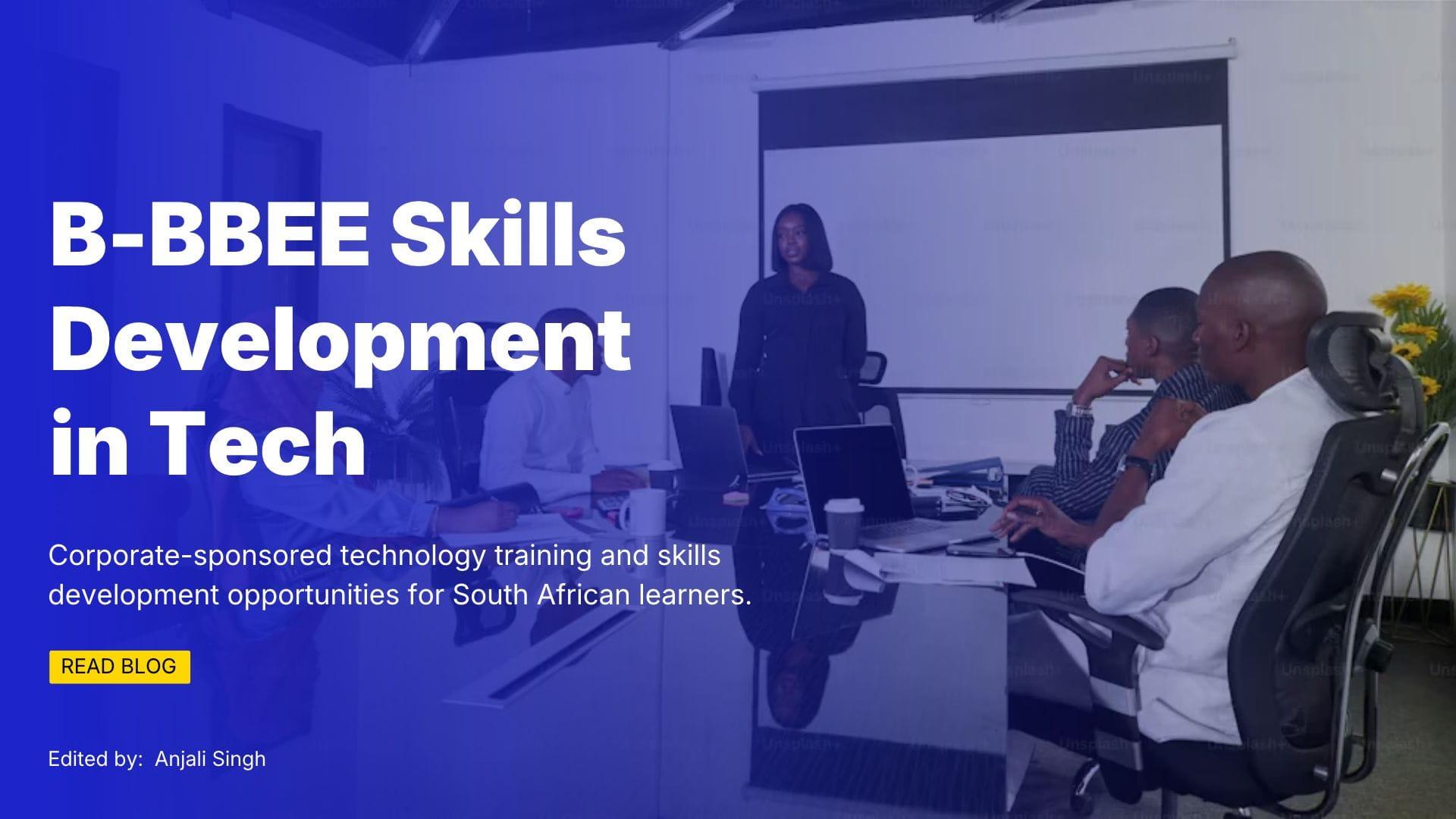
B-BBEE skills development in tech: how companies sponsor bootcamp candidates in South Africa
How do companies sponsor coding training in South Africa? Explore B-BBEE skills development, corporate-funded bootcamps, tax incentives and opportunities for learners.
On this page
- Key takeaways
- What is B-BBEE skills development?
- How can companies use their skills development budgets for tech training?
- Training existing employees
- Sponsoring unemployed candidates
- How does tech training contribute to the B-BBEE scorecard?
- Does sponsoring a coding bootcamp qualify for B-BBEE points?
- Can companies claim Section 12H tax allowances for sponsored training?
- What does a corporate-sponsored coding programme look like?
- Why practical projects matter in sponsored tech training
- How can candidates find corporate-sponsored coding opportunities?
- What should companies look for in a tech training partner?
- How Zaio supports corporate skills development
- Making skills development count beyond the scorecard
- Frequently asked questions
Key takeaways
- B-BBEE skills development allows qualifying South African businesses to earn scorecard recognition for eligible investment in training and developing black South Africans.
- Companies can sponsor tech training for existing employees or unemployed candidates in areas such as software development, data science, AI and cybersecurity.
- Not every coding bootcamp automatically qualifies for B-BBEE points. Recognition depends on the learning programme, beneficiaries, applicable scorecard and supporting documentation.
- Section 12H is a separate tax incentive for employers with qualifying registered learnership agreements. Ordinary bootcamp sponsorship doesn't automatically qualify.
- Sponsored training can support recruitment, but completing a programme doesn't guarantee employment.
- Zaio works with businesses through QCTO-accredited occupational qualifications, skills programmes and tailored corporate training, combining practical projects with learner support.
For companies in South Africa, investing in skills development is about more than meeting B-BBEE requirements. It's also an opportunity to develop technical capabilities, support young people entering the workforce and build a stronger pipeline of future talent.
At the same time, many South Africans are interested in careers in technology but struggle to access the training they need.
Corporate sponsorship can help bring these 2 needs together. A business funds training for eligible learners, while participants gain opportunities to develop practical skills that could support their careers.
But how does this work in practice? Can a company use its B-BBEE skills development budget to sponsor coding bootcamps? Does that spending qualify for tax benefits? And what happens to learners once their training is complete?
Here's what employers and prospective learners should understand.
What is B-BBEE skills development?
Skills Development is an element of South Africa's Broad-Based Black Economic Empowerment (B-BBEE) framework that recognises qualifying investments in training and developing black South Africans.
For businesses measured under the relevant B-BBEE Codes, eligible expenditure on learning programmes, certain bursaries and participation in structured work-based learning can contribute towards the Skills Development scorecard.
The intention is to encourage businesses to invest in developing skills and creating access to economic opportunities.
For example, a company might sponsor software development training for unemployed candidates or help employees improve their data analysis skills.
These initiatives can benefit the people receiving training while potentially contributing towards the company's B-BBEE objectives.
However, the requirements aren't identical for every business. Recognition depends on the applicable scorecard, the type of programme and whether the necessary conditions are met.
That's why skills development planning should begin with both the business's training needs and its compliance requirements.
How can companies use their skills development budgets for tech training?
Technology skills are relevant to almost every industry.
A retail business might want employees who can analyse customer data. A logistics company could benefit from automation, while a financial services organisation may need more cybersecurity expertise.
Businesses can invest in these capabilities through different types of training.
Training existing employees
One approach is to develop the skills of people already working in the organisation.
For example, a company could sponsor employees in operations or administration to study data analysis, allowing them to work more confidently with reports, dashboards and business information.
Other organisations might invest in software development, cloud administration or cybersecurity training to strengthen internal technical teams.
This can help employees develop professionally while addressing skills gaps within the business.
Sponsoring unemployed candidates
Another approach is to fund training for eligible people who aren't currently employed by the organisation.
For example, a business could sponsor a group of candidates to study software development, giving them access to structured learning, mentorship and practical projects.
Depending on how the programme is designed, participants may also receive career preparation or opportunities for workplace experience.
This can be valuable for learners who might otherwise struggle to afford technical education.
However, sponsoring unemployed candidates doesn't automatically create a registered learnership or guarantee B-BBEE recognition. The programme still needs to meet the applicable requirements.
How does tech training contribute to the B-BBEE scorecard?
Under South Africa's amended generic B-BBEE Codes, Skills Development is measured through qualifying expenditure, participation in specified learning programmes and certain employment outcomes.
For businesses subject to the generic scorecard, the following indicators are particularly relevant.
These are indicators under the amended generic Codes, not universal spending obligations for every South African business.
Sector-specific Codes, business size and the relevant verification requirements can affect how the scorecard applies.
B-BBEE scorecard recognition, tax incentives and future recruitment opportunities are 3 separate considerations. A programme may support one without automatically qualifying for all 3.
Before funding a cohort, employers should confirm how the proposed training will be treated under their applicable B-BBEE framework.
Does sponsoring a coding bootcamp qualify for B-BBEE points?
It may, but the answer depends on the programme and how the sponsorship is structured.
For example, a company might sponsor 10 learners to complete a software development programme covering JavaScript, React, backend development and databases.
That could support the company's broader skills development strategy, but the B-BBEE treatment depends on several factors.
The company needs to consider whether the learning programme falls within the relevant recognition requirements, whether the beneficiaries are eligible and what records must be maintained.
A full Occupational Certificate, a recognised occupational skills programme and a private bootcamp offer different learning pathways and credentials.
A training provider may have QCTO accreditation for particular occupational qualifications while also offering shorter programmes with different certification arrangements.
That means employers shouldn't assume that every course offered by an accredited institution has the same recognition.
Our advice is to involve your skills development facilitator or B-BBEE verification adviser before finalising the sponsorship.
This helps ensure that the training programme supports both your business objectives and the requirements you need to meet.
Can companies claim Section 12H tax allowances for sponsored training?
Section 12H of South Africa's Income Tax Act provides additional tax deductions for employers participating in qualifying registered learnership agreements. These allowances are intended to encourage structured workplace learning and skills development.
However, there's an important distinction.
Funding a coding bootcamp doesn't automatically qualify a company for a Section 12H deduction. To qualify, the employer must meet the requirements for an eligible registered learnership agreement.
According to SARS guidance applicable in November 2026, the incentive covers qualifying agreements entered into before 1 April 2027, subject to the relevant legislative conditions.
Employers may qualify for annual and completion allowances, but the amounts and eligibility depend on the circumstances.
For this reason, companies shouldn't include Section 12H benefits in their training budgets without first confirming that the proposed arrangement qualifies.
The SARS guidance on learnership agreements provides more detail about the requirements.
What does a corporate-sponsored coding programme look like?
Let's say a South African company wants to sponsor software development training for 15 candidates. The first step shouldn't necessarily be choosing a course. It should be identifying what the business wants to achieve.
Perhaps the company wants to develop a pool of junior technical talent, support unemployed youth or strengthen its contribution to digital skills development.
The training provider and employer can then work together to determine the right programme and the support learners will need.
A typical process might look like this.
This is an illustrative model. The actual structure will depend on the employer, learning programme and funding arrangement.
For employers, the value comes from being able to assess more than attendance.
A learner who has built a working application, completed technical assessments or demonstrated new workplace skills gives the business a clearer picture of what the training has achieved.
Why practical projects matter in sponsored tech training
Learning a programming language is useful, but applying that knowledge to solve a problem is where technical understanding develops.
This is particularly important in software development, where employers may want candidates to demonstrate what they can build.
For example, a sponsored learner studying full-stack development could create an application that allows a small business to manage orders or inventory.
The project would involve frontend development, backend APIs, a database and testing.
For a company sponsoring the programme, this provides a more meaningful outcome than simply knowing that the learner completed a certain number of lessons.
The same principle applies to data science and cybersecurity.
Learners should have opportunities to work with relevant tools and demonstrate how they approach technical problems.
When evaluating training providers, businesses should therefore consider the practical learning experience alongside the qualification and compliance requirements.
How can candidates find corporate-sponsored coding opportunities?
If you're looking for a coding bursary or sponsored bootcamp in South Africa, you'll find opportunities funded by employers, bursary programmes and youth development initiatives.
Some companies fund training for existing employees. Others support unemployed candidates through bursaries, sponsored cohorts or youth employment initiatives.
The funding may cover tuition, while certain programmes may also provide stipends or workplace experience.
However, these benefits aren't universal.
Before applying, check the eligibility criteria, what expenses are covered, whether attendance is compulsory and what qualification or certificate you'll receive.
You should also establish whether employment is part of the programme.
Some sponsorships are designed to develop a potential recruitment pipeline, but others focus on training without a guaranteed job at the end.
A useful starting point is to follow official announcements from education providers, participating employers and recognised youth employment initiatives.
When you find an opportunity, apply through the official channel rather than assuming that every advertised grant or sponsored course is legitimate.
What should companies look for in a tech training partner?
If your organisation is considering funding technology training, the provider should offer more than a course catalogue. The right partner should understand what your learners need to achieve and how their progress will be measured.
We recommend looking at 4 areas.
- Relevant curriculum: The programme should teach skills connected to your organisation's needs, whether that's software development, AI, data science, cybersecurity or cloud technologies.
- Practical learning: Learners should work on projects and assessments that allow them to apply the skills they're developing.
- Learner support: Scheduled sessions, access to tutors and regular feedback can help participants progress through the programme.
- Progress reporting: Employers need visibility into attendance, learner performance and completion, especially when the training forms part of a formal skills development initiative.
Accreditation is another important consideration when the proposed training requires a recognised qualification.
Ask for the exact registered qualification and provider accreditation details rather than relying on a general statement that the institution is accredited.
How Zaio supports corporate skills development
At Zaio, we work with businesses that want to develop technical skills within their teams or create learning opportunities for new talent.
Our approach starts with understanding what the organisation needs learners to achieve. From there, we help identify an appropriate programme and the support needed throughout the learning process.
For employers looking at formal occupational qualifications, Zaio offers QCTO-accredited programmes including Occupational Certificate: Software Developer, Occupational Certificate: Data Science and Occupational Certificate: Cybersecurity, all registered at NQF Level 5.
We also offer the Occupational Certificate: Cloud Administrator at NQF Level 4, alongside other accredited occupational qualifications.
These programmes have defined qualification requirements, including knowledge, practical and workplace learning components.
For businesses focused on developing particular technical capabilities, our bootcamps cover areas including full stack web development, full stack AI engineering, data science, cybersecurity and cloud & DevOps.
Our training takes place online, with scheduled live sessions, access to tutors and mentors, and practical projects that help learners apply what they've studied.
We also offer career preparation support, including CV and portfolio reviews, mock interviews and introductions to hiring partners. While these services help learners prepare for opportunities, employment and placement are not guaranteed.
The right training arrangement depends on what your organisation wants to achieve and which B-BBEE requirements apply.
If you're exploring ways to support technology skills development, you can learn more about Zaio's corporate training options or book a consultation to discuss your organisation's needs.
Making skills development count beyond the scorecard
B-BBEE skills development provides an important reason for companies to invest in training, but the value shouldn't end when the verification process is complete.
For employers, sponsored technology training can help develop useful capabilities and create connections with potential future talent.
For learners, it can provide access to education, practical experience and career preparation that might otherwise be difficult to afford.
The strongest programmes consider both sides.
Before committing to a sponsorship, businesses should understand the applicable B-BBEE requirements, select a suitable learning pathway and decide how they'll measure the results.
When corporate skills development is built around meaningful learning outcomes, it can create value for both the business funding the programme and the people developing their careers.
Frequently asked questions
- What is B-BBEE skills development?
B-BBEE skills development is an element of South Africa's empowerment framework that recognises qualifying investments in training and developing black South Africans.
- Can companies earn B-BBEE points by sponsoring coding bootcamps?
Potentially. Recognition depends on the learning programme, beneficiary eligibility, applicable scorecard and supporting documentation. Funding a bootcamp doesn't automatically guarantee points.
- Does sponsoring a coding bootcamp qualify for Section 12H?
Not automatically. Section 12H applies to qualifying registered learnership agreements that meet SARS requirements. Sponsoring a coding bootcamp doesn't automatically make an employer eligible for the tax allowance.
- Can businesses sponsor unemployed youth to learn coding?
Yes. Companies can sponsor eligible unemployed candidates through corporate-funded training, bursaries or structured skills development initiatives, depending on the programme.
- Are corporate-sponsored coding courses free for learners?
Some are fully funded, while others cover only certain costs. Learners should confirm whether tuition, equipment, data costs or stipends are included.
- Does corporate-sponsored training guarantee employment?
No. Some programmes offer workplace experience or recruitment opportunities, but completing sponsored training doesn't automatically guarantee a job.
- Does Zaio offer corporate skills development programmes?
Yes. Zaio offers employer-sponsored training, QCTO-accredited occupational qualifications, occupational skills programmes and tailored corporate training in technology-related fields.
Written by
Anjali Singh