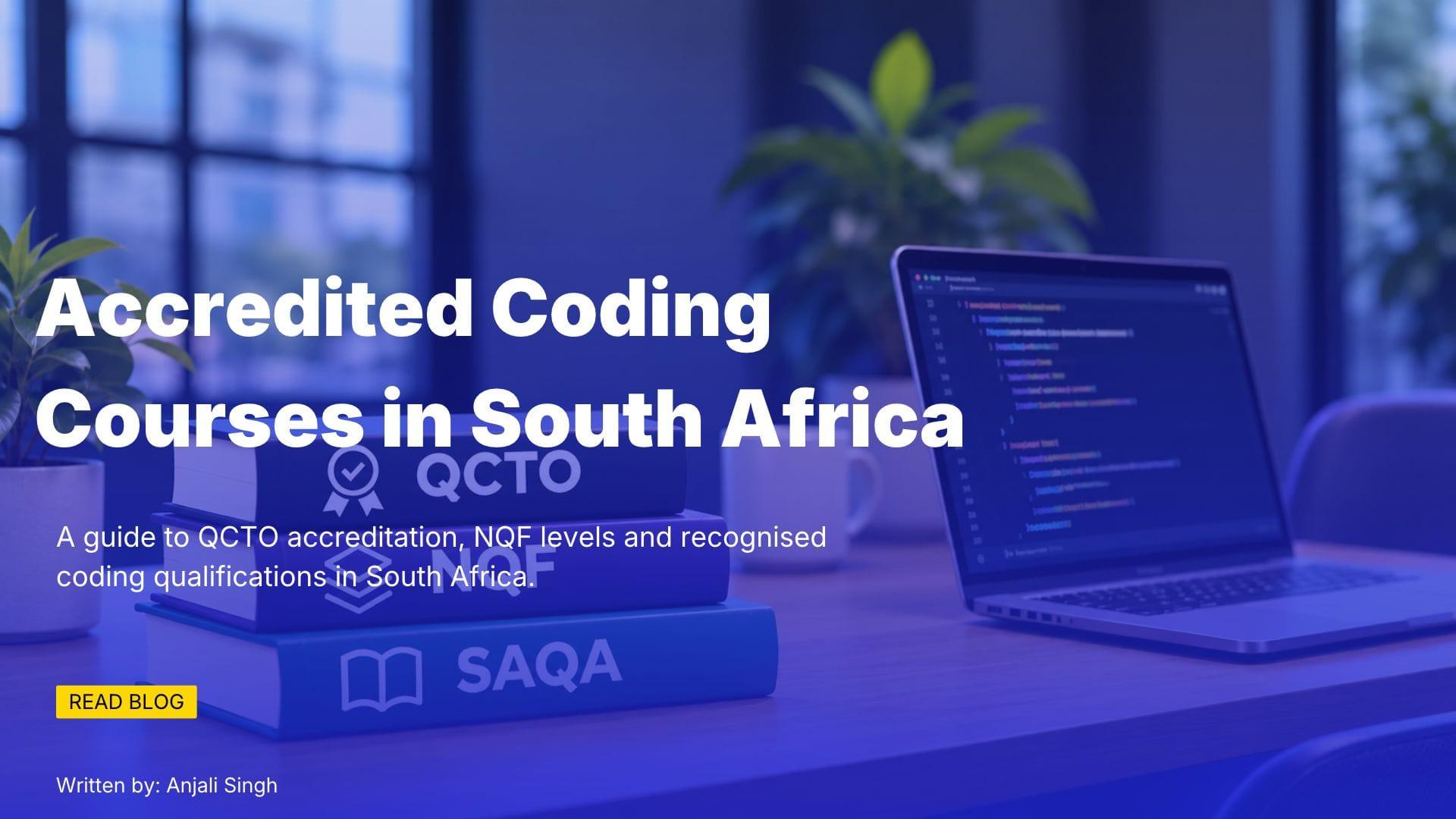
Accredited coding courses in South Africa: what QCTO and NQF levels actually mean
Not sure what QCTO accreditation and NQF levels mean? Learn how coding qualifications work in South Africa and what to check before enrolling.
On this page
- Key takeaways
- What does it mean when a coding course is accredited?
- What are QCTO, SAQA and NQF?
- Understanding NQF Level 4 and Level 5 qualifications
- Does a coding course need to be accredited to get you a job?
- Accredited qualifications vs coding bootcamps vs online certificates
- Which option is better?
- How to check if a coding course is really accredited
- How much should accreditation influence your choice?
- Explore your study options at Zaio
- Frequently asked questions
Key takeaways
- Accredited coding courses in South Africa can lead to nationally recognised qualifications, but not every coding course or bootcamp is accredited.
- QCTO accreditation means a training provider is approved to offer specific occupational qualifications or skills programmes.
- NQF levels describe the level of learning. NQF Level 4 and Level 5 qualifications differ in complexity, but the level alone doesn't determine how valuable a course will be for your career.
- SAQA registration and QCTO accreditation are different. A qualification can be registered nationally without every training provider being approved to offer it.
- Accreditation doesn't guarantee employment. Employers may consider formal qualifications alongside technical skills, experience and practical projects.
- Always verify a course before enrolling. Check its SAQA ID, NQF level, provider accreditation and the qualification or certificate you'll actually receive.
When choosing a coding course in South Africa, you'll often come across terms like QCTO accreditation, NQF levels and SAQA registration. But what do these actually mean, and how important are they when choosing where to study?
Not all coding courses lead to the same type of qualification. Some offer nationally recognised Occupational Certificates, while others focus on practical skills and provide certificates of completion. Both can be valuable, but they serve different purposes.
Understanding these differences can help you make a more informed decision, especially if you're looking to start a career in tech, change careers or gain a formal qualification.
What does it mean when a coding course is accredited?
When a course is advertised as accredited, it means that a recognised quality assurance body has approved certain aspects of the education or training being offered.
In South Africa, the Quality Council for Trades and Occupations (QCTO) is responsible for accrediting providers of occupational qualifications and skills programmes.
For example, if a training provider wants to offer a nationally recognised Occupational Certificate in Software Development, it needs approval to deliver that particular qualification.
The QCTO assesses whether the provider meets the relevant requirements, including its ability to deliver the programme.
However, here's something many learners don't realise. Just because an institute is accredited doesn't mean every course it offers is accredited.
An education provider might be approved to offer an Occupational Certificate but also run shorter bootcamps that have a different type of certification.
That doesn't automatically make the shorter courses bad. It simply means the qualifications and certificates are different, and you should understand what you're enrolling for.
You can learn more about how this works through the QCTO's official accreditation guidance.
What are QCTO, SAQA and NQF?
These 3 terms appear frequently when researching accredited courses, but they don't mean the same thing.
Here's a simple breakdown.
For example, Zaio's Occupational Certificate: Software Developer is registered at NQF Level 5 under SAQA ID of 118707. This confirms that it's a nationally registered qualification. Zaio also holds QCTO accreditation to offer the programme (accreditation no. 07-QCTO/SDP220925101328), meaning learners can work towards a formally recognised occupational qualification.
When comparing courses, it's worth checking both the qualification's SAQA registration and the training provider's QCTO accreditation to make sure you know exactly what you're enrolling for.
Understanding NQF Level 4 and Level 5 qualifications
When comparing coding courses in South Africa, you'll often see qualifications listed at NQF Level 4 or Level 5. But what does that actually tell you about the course?
The National Qualifications Framework has 10 levels, which reflect the complexity of the knowledge and skills covered by a qualification.
NQF Level 4 includes qualifications at the same level as the National Senior Certificate and National Certificate (Vocational), while NQF Level 5 represents a higher level of learning and includes qualifications such as Higher Certificates and certain Occupational Certificates.
However, 2 qualifications at the same NQF level aren't necessarily equivalent. They can cover different subjects, have different assessment requirements and prepare learners for different career paths.
For example, Zaio's Occupational Certificate: Cloud & DevOps Engineering is registered at NQF Level 4, while our Occupational Certificate: Software Developer is registered at NQF Level 5. Both are nationally registered qualifications, but they're designed to develop skills for different roles.
So, does that mean NQF Level 5 is always the better choice? Not necessarily.
If you're interested in cloud infrastructure, an NQF Level 4 qualification focused on Cloud & DevOps Engineering may be more relevant to your career goals than an NQF Level 5 qualification in software development.
The NQF level tells you how a qualification is classified, but the curriculum tells you what you'll actually learn. When choosing a programme, consider both the level and whether the skills it covers match the career you want to pursue.
Does a coding course need to be accredited to get you a job?
No, you don't necessarily need an accredited coding qualification to get a job in tech. It depends on the role you're applying for and what the employer is looking for.
Some companies require candidates to have a recognised degree, diploma or occupational qualification. Others are more interested in whether you have the technical skills to do the job, regardless of how you learned them.
For example, if you're applying for a junior software developer position, an employer might want to see that you understand JavaScript, can work with databases and know how to build a functioning application. You may also be asked to complete a coding assessment or talk through projects you've worked on.
This is where having a portfolio becomes valuable. Instead of only listing the technologies you've learned on your CV, you can show employers what you've actually built and explain how you approached the work.
An accredited qualification can strengthen your application, particularly for roles with formal education requirements. But it doesn't automatically make you more employable than someone who completed a bootcamp or learned independently.
Our advice is to look at both the qualification and the practical skills you'll develop. Whether you choose an Occupational Certificate or a shorter coding programme, make sure you're gaining the knowledge and experience needed for the career you want to pursue.
If you're starting to build your portfolio, we've put together a guide on how to build a tech portfolio that helps you land a job.
Accredited qualifications vs coding bootcamps vs online certificates
One of the reasons choosing a coding course can be confusing is that there are several ways to learn programming, and they don't all lead to the same type of qualification.
You might complete a university diploma, study towards an Occupational Certificate, join a coding bootcamp or learn independently through an international online platform.
Each option can be useful, depending on what you want to achieve.
Which option is better?
If you're looking for a formal qualification that is recognised within South Africa's education system, an accredited Occupational Certificate or university qualification may be more appropriate.
If you're already working and want to develop a particular skill, such as frontend development, a shorter bootcamp might fit your schedule better.
And if you simply want to explore coding before committing to a longer programme, free or low-cost online courses can be a useful starting point.
None of these choices is automatically right for everyone.
The important thing is to know the difference between learning a skill and obtaining a particular qualification.
How to check if a coding course is really accredited
Before enrolling in a coding course, it's worth taking a few minutes to verify its accreditation, especially if you're looking for a nationally recognised qualification.
Start by asking the training provider for the qualification's full name, SAQA ID, NQF level and QCTO accreditation number. These details should help you identify exactly what qualification the programme leads to.
You can then search for the qualification on the SAQA qualifications register to confirm its registration, NQF level and credits. It's also important to check that the provider is accredited by the QCTO to offer that specific qualification.
Finally, confirm what you'll receive after completing the course. A full Occupational Certificate, an occupational skills programme and a bootcamp certificate can have different forms of recognition.
Our advice is simple: don't rely on the word "accredited" alone. Make sure you understand what the accreditation covers and what qualification you'll be working towards before you enrol.
How much should accreditation influence your choice?
Accreditation is important, but it shouldn't be the only thing you consider. You might find 2 accredited programmes at the same NQF level, yet one covers technologies more relevant to the career you want.
Or you might compare a formal Occupational Certificate with a shorter bootcamp and realise that the bootcamp's practical focus better suits your immediate learning goals.
Before deciding, consider the following:
- Your career goal: Are you aiming for software development, cybersecurity, data analysis or another field?
- The qualification: Do you need a nationally registered qualification, or are you primarily learning a new skill?
- The curriculum: Does the programme cover the technologies and practical knowledge relevant to your chosen role?
- The learning experience: Are there projects, instructors, mentors or opportunities to ask questions?
- The commitment: Can you manage the programme's duration, schedule and total cost?
A course should be judged on what it teaches, the qualification it provides and how well it prepares you for your next step.
Explore your study options at Zaio
Choosing a coding course comes down to what you want to achieve, the skills you want to develop and the type of qualification you're looking for.
At Zaio Institute of Technology, we offer QCTO-accredited Occupational Certificates alongside shorter, practical bootcamps.
Our programmes combine structured learning, practical projects and support from experienced mentors to help learners develop relevant technical skills.
Whether you're interested in a formal Occupational Certificate or a shorter programme, we can help you understand the curriculum, qualification and learning experience before you enrol.
You can explore our programmes or book a consultation to find out more.
Frequently asked questions
- What does QCTO-accredited mean?
QCTO accreditation means a training provider has been approved to offer specific occupational qualifications or skills programmes within its accreditation scope.
- Is QCTO accreditation recognised in South Africa?
Yes. The QCTO is an official South African quality council responsible for occupational qualifications and skills programmes under the National Qualifications Framework.
- What is the difference between QCTO and SAQA?
SAQA oversees the National Qualifications Framework and maintains registered qualification information. QCTO is responsible for quality assurance and accrediting providers of occupational qualifications and skills programmes.
- Is NQF Level 4 the same as matric?
No. Although matric is registered at NQF Level 4, other qualifications at the same level are not automatically equivalent to the National Senior Certificate.
- Is NQF Level 5 better than Level 4?
NQF Level 5 represents a higher level of learning complexity, but that doesn't automatically make it the better choice for every learner. The qualification's content, purpose and relevance to your goals also matter.
- Do you need an accredited coding course to become a software developer?
Not always. Some employers require particular qualifications, while others assess programming skills, practical projects and experience. Check the requirements for the roles you're interested in.
- Are Zaio's coding courses QCTO-accredited?
Zaio offers QCTO-accredited Occupational Certificates alongside shorter bootcamps. The accreditation status and credential awarded depend on the programme, so confirm the details of the course you're considering.
- Does an accredited coding course guarantee a job?
No. Accreditation confirms particular educational quality requirements, but getting hired also depends on your technical skills, practical experience, applications and the employer's requirements.
Written by
Anjali Singh