Finding your purpose is not always a straight path.
For some people, it starts with a clear dream. For others, it takes a few wrong turns, difficult decisions, and moments of self-doubt before things begin to make sense.
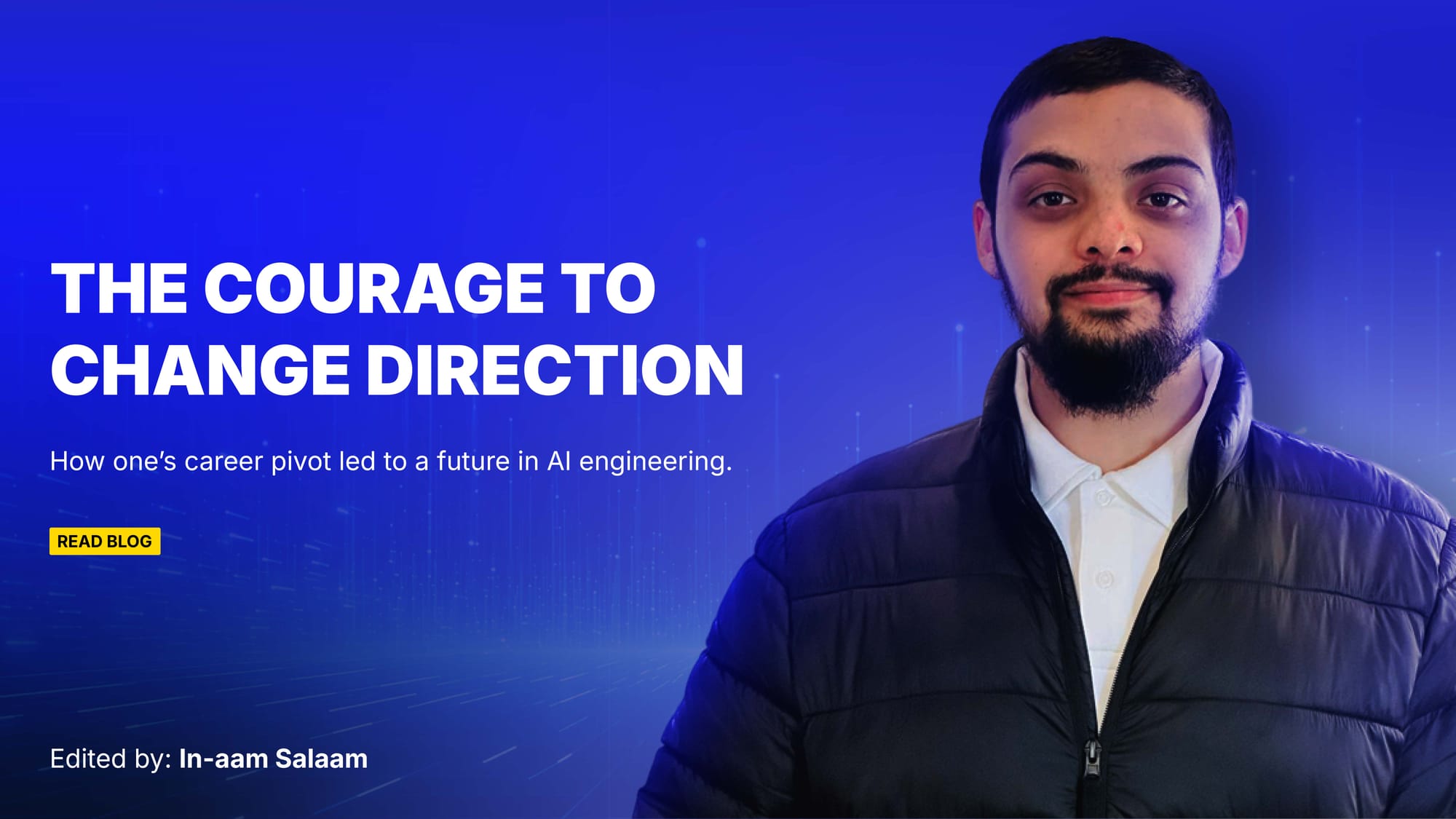
For Abdullah Ali, that journey started in medicine.
Today, Abdullah is a final-year Computer Science student and a learner in Zaio’s Full Stack AI Engineering Bootcamp. But before he found his place in software engineering, he had to make one of the hardest decisions of his life: stepping away from a career path that looked successful from the outside, but no longer felt aligned with who he was becoming.
Like many South Africans trying to find their way, Abdullah initially chose a path that felt stable, respected, and meaningful. Medicine was built around helping people, and for a long time, that made sense. But as he moved through his studies, he began to realise that purpose is not only about choosing a respected career. It is also about finding work that matches your strengths, curiosity, and the kind of problems you want to solve.
His story is not just about switching from medicine to Computer Science. It is about resilience, self-awareness, grief, imposter syndrome, and the courage to start again.
It is also a reminder that a career in tech does not always begin with certainty. Sometimes it begins when you are brave enough to admit that the path you are on is no longer the one meant for you.
A Problem Solver Before He Was a Developer
Before Abdullah saw himself as someone in tech, he already had many of the traits that make a strong developer.
He was curious. He liked understanding how things worked. He enjoyed breaking complex ideas down and helping others understand them. Alongside his studies, he spent six years tutoring high school Mathematics and Physical Science, which became more than just a way to teach. It strengthened the same skills that matter deeply in software engineering: communication, patience, problem-solving, and the ability to explain difficult concepts clearly.
That tutoring experience shaped him in ways he probably did not fully realise at the time. Teaching forces you to think differently. You cannot just know the answer; you have to understand the process well enough to guide someone else through it. In many ways, that is very close to what good developers do. They take messy problems, break them into smaller parts, and work toward a solution that others can understand and use.
Outside of academics, Abdullah remained drawn to learning, sport, creative tools, and anything that allowed him to explore how systems connect. Looking back, tech was not a random switch. It was a natural extension of how he already thought.
The Career Pivot That Changed Everything
After matriculating in 2019, Abdullah began studying medicine.
For many students, that would have felt like a dream. Medicine is one of those fields people associate with success, purpose, and security. It is the kind of career path that carries weight, especially in communities where certain professions are seen as signs that you have “made it”.
But a prestigious path is not always the right path.
By his second year, Abdullah started to realise that although medicine was meaningful, it was not where his strengths and interests truly aligned. He faced academic challenges, culture shock, and the quiet pressure of imposter syndrome, the kind that makes you question whether you belong even when you are trying your best.
This is the part of career change that people do not talk about enough. It is not always a dramatic moment where everything becomes clear. Sometimes it is slower than that. You try to push through. You question yourself. You wonder if you are giving up too soon or being honest with yourself for the first time.
For Abdullah, the answer came through reflection. In 2022, he made the decision to leave medicine and move into Computer Science.
It was a brave decision because changing direction is never easy, especially when the path you are leaving is one that many people would consider successful. But from his first Computer Science lecture, something clicked. He knew he was in the right place.
For the first time, the work felt connected to the way he naturally thought. It challenged him, but it also energised him. That difference mattered.
Discovering a Passion That Had Always Been There
Abdullah’s interest in technology did not appear overnight.
In many ways, it had been around him for years. His late father was an electrical engineer, and his older brother had already entered the tech industry. Technology was part of the environment he grew up in, even if he did not immediately see it as his own future.
During the pandemic, that interest became more personal when he built his first gaming PC. What started as a project quickly became something deeper. He found himself troubleshooting, experimenting, learning how components worked together, and enjoying the process of figuring things out.
That experience helped him see technology differently. It was no longer just something people used. It was something he could understand, build with, and shape.
This is often how passion develops. Not always through one big moment, but through a series of small experiences that keep pulling you in. For Abdullah, those experiences eventually pointed him toward Computer Science and software engineering.
Learning Through Difficult Seasons
Success stories often sound neat once they are written down. The person struggled, found their path, worked hard, and everything changed.
Real life is rarely that clean.
For Abdullah, the transition into university came with real challenges. He had to deal with self-doubt, pressure, and the feeling of being in spaces where everyone else seemed more confident. Imposter syndrome became part of the journey, and like many students, he had to learn how to keep going even when he did not always feel sure of himself.
Then, in 2024, life became even heavier. Abdullah experienced the loss of both his father and uncle while still trying to manage the demands of university.
That kind of loss changes a person. It can slow you down, shake your confidence, and make even ordinary responsibilities feel harder. But it can also reveal a level of strength you did not know you had.
Abdullah did not pretend the challenges were easy. Instead, he allowed them to shape him. Over time, those difficult seasons taught him resilience, discipline, and the importance of continuing even when life does not make things simple.
That resilience became part of his growth as a person and as a future software engineer.
Why He Joined Zaio’s Full Stack AI Engineering Bootcamp
Like many Computer Science students, Abdullah understood that university gave him important foundations. But he also wanted something more practical. He wanted to build real projects, gain hands-on experience, and become more confident applying what he was learning.
Eventually, he came across Zaio through a TikTok video. After reading one of Zaio’s learning roadmaps, he immediately connected with the structure. It gave him a clearer sense of direction and showed him how different parts of the learning journey could fit together.
What stood out to him was the combination of full stack development, AI engineering, portfolio building, mentorship, and accountability. It was not just theory. It was a practical pathway designed to help learners build skills they could actually show.
The AI engineering component also mattered. Abdullah could see that artificial intelligence was becoming a major part of the future of work, and he did not want to prepare for yesterday’s version of tech. He wanted to build skills that would remain relevant as the industry continued to change.
For him, joining Zaio was not about replacing his degree. It was about strengthening it with practical experience, structure, and a community that could help him keep moving.
Is a Coding Bootcamp in South Africa Worth It?
A lot of aspiring developers ask whether a coding bootcamp is worth it in South Africa.
Abdullah’s view is honest: it depends on how seriously you take it.
A bootcamp is not a golden ticket. It does not remove the need for discipline, practice, or consistency. It will not do the work for you. But the right bootcamp can give you structure, support, mentorship, accountability, and projects that help you grow faster than you might on your own.
That distinction matters.
Many people try to learn tech by jumping between random tutorials, YouTube videos, short courses, and advice from different creators. There is nothing wrong with self-learning, but it can become confusing when there is no clear path. You spend more time deciding what to learn than actually learning.
A structured bootcamp helps reduce that confusion. It gives learners a sequence, a community, and a reason to keep showing up.
For Abdullah, Zaio helped him build practical confidence. Combined with his Computer Science degree, the bootcamp gave him more experience creating projects, applying concepts, and preparing for real opportunities. It also contributed to him securing an internship and strengthening his career prospects.
That is where a bootcamp can be powerful. Not as a shortcut, but as an accelerator for people willing to commit.
The Role of Collaboration in Becoming a Developer
At first, Abdullah preferred studying alone.
That is common, especially for people who are used to relying on their own discipline. But over time, he realised that software development is rarely a solo activity in the real world. Developers work in teams. They explain ideas, give feedback, review code, manage deadlines, and build products with other people.
Collaboration became an important part of his growth.
Through university projects, Abdullah stepped into leadership roles and learned how to work with different personalities, balance different opinions, and keep a team moving toward a shared goal. These experiences helped him see that communication is not separate from technical ability. It is part of it.
His teams went on to achieve strong recognition, including Top 3 Project of the Year and Game of the Year awards. But beyond the awards, the real lesson was that technical skills alone are not enough. The best developers are not only people who can write code. They are people who can think clearly, work with others, and solve problems in a way that moves a team forward.
That is a lesson many aspiring developers should take seriously.
Building a Portfolio That Proves What You Can Do
One of Abdullah’s strongest beliefs is that degrees alone are not enough.
A degree can show that you studied the theory. A certificate can show that you completed a programme. But a portfolio shows what you can actually build.
This is especially important in tech, where employers want evidence. They want to see projects. They want to understand how you think. They want to know whether you can take an idea, work through challenges, and turn it into something functional.
Through Zaio’s Full Stack AI Engineering Bootcamp, Abdullah gained more confidence in building projects that could showcase his abilities. That practical experience helped bridge the gap between theory and real-world application.
For anyone considering an online coding bootcamp in South Africa, this is one of the biggest lessons: your portfolio matters.
Employers do not only hire qualifications. They hire problem solvers. A strong portfolio helps prove that you are one.
Learning Never Stops in Tech
One of the things Abdullah has learned is that technology does not stand still.
New tools appear all the time. Frameworks change. Languages evolve. AI continues to reshape how developers work. It can be tempting to chase every new trend, but Abdullah believes the foundations matter most.
Problem-solving, algorithms, communication, critical thinking, and the ability to keep learning will always remain valuable. Tools may change, but the mindset of a strong developer stays relevant.
This is an important reminder for anyone entering tech. You do not need to know everything before you start. In fact, nobody in tech knows everything. Even senior developers are constantly learning, adapting, and figuring things out.
That is not a weakness of the industry. It is part of what makes it exciting.
The goal is not to become someone who knows every tool. The goal is to become someone who can keep learning, keep solving problems, and keep growing as the field changes.
Abdullah’s Advice for Aspiring Developers
When Abdullah speaks to other students or aspiring developers, his advice is practical.
First, do your research. Tech is a broad industry, and software development is only one part of it. There is cybersecurity, data science, AI, cloud computing, product, design, and many other paths. The more you understand your options, the easier it becomes to choose a direction that fits your strengths.
Second, lock in. Tech rewards consistency. You do not need to learn everything at once, but you do need to commit to the process. The people who make progress are usually not the ones who find the easiest shortcut. They are the ones who keep showing up.
And finally, embrace the process. There is no six-day course that turns you into a developer. There is no magical certificate that replaces practice. There is no golden ticket. Growth comes from curiosity, repetition, mistakes, feedback, and persistence.
That may sound simple, but it is often the difference between people who start and people who finish.
Looking Ahead
Abdullah’s immediate goal is to secure a junior software engineering role and continue growing in the industry.
He is open to opportunities that offer learning, mentorship, and real experience because he understands that career growth is not something that happens overnight. It is a long-term process, and the early stages matter.
Long term, he wants to become an exceptional engineer while continuing to build his knowledge in AI and full stack development.
Given his mindset, resilience, and willingness to keep learning, that future feels very possible.
What Abdullah’s Journey Teaches Us About Purpose
Abdullah’s journey matters because it reflects something many people need to hear: your path does not have to be perfect to be meaningful.
He started in medicine and found his way to software engineering. He dealt with self-doubt, personal loss, academic pressure, and the uncertainty that comes with changing direction. But through it all, he kept moving.
That is what makes his story powerful.
It is not just a story about tech. It is a story about choosing honesty over expectation. It is about realising that setbacks do not have to end your journey. Sometimes, they redirect you toward the work you were meant to do.
At Zaio, we believe talent exists everywhere. Sometimes people simply need the right structure, the right support, and the right environment to unlock it.
Abdullah found that through curiosity, persistence, and a commitment to lifelong learning.
And maybe that is the biggest lesson of all: you do not need a perfect path. You need the courage to keep moving forward.
Ready to Start Your Own Tech Journey?
Whether you are exploring software engineering, AI, data science, or full stack development, Zaio provides the mentorship, structure, and community to help you build practical skills and grow with confidence.
Apply today, build your portfolio, and take the first step toward your future in tech.
Explore Zaio’s Full Stack AI Engineering Bootcamp
Frequently Asked Questions
1. Is a coding bootcamp worth it in South Africa?
Yes, if you are willing to put in the work. A coding bootcamp can give you structure, mentorship, practical projects, and support that help you build job-ready skills faster.
2. Can a bootcamp replace a Computer Science degree?
Not always. A degree builds strong theoretical foundations, while a bootcamp focuses more on practical skills and portfolio-building. For many learners, the two can work well together.
3. Can I become a software developer without a tech background?
Yes. Many people enter tech from completely different backgrounds. What matters most is building strong fundamentals, practising consistently, and creating projects that show what you can do.
4. Why is a portfolio important for software developers?
A portfolio gives employers proof of your skills. It shows what you have built, how you solve problems, and whether you can apply what you have learned in a practical way.
5. Is AI engineering a good career path?
Yes. AI is becoming part of many industries, and learning how to build with AI tools can give developers a strong advantage as the tech industry continues to evolve.
6. What makes Zaio’s Full Stack AI Engineering Bootcamp different?
Zaio combines full stack development, AI engineering, mentorship, accountability, and portfolio-building to help learners build practical skills for the future of work.